Saturday, April 29, 2023

Seraphic Virgin, Passionate Lover of the Crucified Christ - Scolder of Popes?

Today is the Memorial of the Seraphic Virgin - St Catherine of Siena. 


St Catherine is one of those eccentric, passionate and unusual saints that we may struggle to understand or relate to. She experienced visions of Jesus and Mary, fell into ecstasies for long periods of time, received an invisible stigmata and in one of her visions she was mystically married to Jesus Himself. During her ecstasies she dictated to others her dialogue between God and herself, this book is her most well known. She apparently lived only on the Eucharist at some points in her life, and intensely fasted to the point that some modern authors have considered her to have been anorexic! 

Many of us often think she was a nun due to her wearing a habit in pictures. However she was technically a laywoman! She was a Third Order Dominican, which meant she had the privilege of wearing a modified version of the habit, but lived in her own home and not in a convent. These women were sometimes known as the Mantellate - due to them wearing veils associated with nuns. 

St Catherine had some excellent insights on the spiritual life as part of her doctrine, and this has been verified by the Church when she was declared a Doctor of the Church in 1979 by Pope St Paul VI. From the little I know of her teachings, the following have stood out for me - the inner cell of self knowledge, Christ as the bridge, her obsession with the Blood of Christ, and her dedication to Church reform. 

St Catherine taught that all of us have the ability to create an inner sanctuary, room or cell (referring to the bedrooms of monasteries) where we can continuously dwell alone with God within us. In this cell within, we must learn about ourself and our true intentions, through rooting out sin and vice - and growing in virtue and holiness, the more we know who we really are, then the closer we come to God. This is very similar in many ways to the Carmelite mystical tradition of the Divine Indwelling and St Teresa of Avila’s insistence on self knowledge to progress in the spiritual life. They were both proclaimed the first ever female Doctors of the Church within 4 days of eachother. 

Her image of Christ the Bridge that unites heaven and earth is one that I have found helpful in my own spiritual life. It is the sacred humanity of Christ that becomes the bridge and sure way that we can safely pass over to heaven and to God. This is also linked to what can be termed as her obsession the Blood of Christ. In her letters she often refers to being washed, bathed, immersed, covered, drowned and even inebriated/drunk on the Blood of Christ - because it is what saved us, purifies is, protects us and also inflames us with divine charity. It is truly powerful stuff. 

Last but not least was her dedication to Church reform and her devotion to the Papacy. During her time there was a schism with two different Popes - one residing in Rome and the other in Avignon. This was because previously the Popes had moved to Avignon in France due political issues. She encouraged the Pope to move back to Rome, basically telling him to “man up” and do the right thing! Later on there was an issue with two rival popes - and she supported the correct one that history has shown was the legitimate pope. 

Can you imagine the turmoil of the time in which she lived? The Bishops of Rome, the Popes, had been living in Avignon France for about 70 years, there was spiritual and moral decay, political infighting in the Church among the Cardinals and bishops…. See things never really change that much!! And this was 600 years ago! ๐Ÿ˜‚

But she steadfastly strove for her own holiness first, and then worked to encourage others around her. She had a group of followers around her who affectionately called her “mama” and who would distribute her letters or write them down. These letters were often for Cardinals and even the Pope himself! She would encourage them, plead with them and urge them to be good shepherds to look after the People of God. She became very influential and later on, she herself was requested by the Pope to be his messenger and to mediate some disputes. All through this, she fasted for the Pope and the Church. 

She was someone who had moral authority, people would listen to her, she had her own disciples and was known as someone who was a mystic who had supernatural knowledge and visions. She could have easily gotten so frustrated with the Church and tried to create her own church. I am sure many would have followed her and she could have easily been the leader of this new church. However she did not. She believed that the Pope was the “sweet Christ on earth” and that no matter how weak or sinful or cowardly or corrupt he may be - he deserves our respect, because he represented Christ on earth as His Vicar. What faith and humility she must have had! 

Now many of you might say, hang on a minute, how can you say she was humble when she wrote letters to the Pope himself and told him to man up and do his job! That doesn’t sound like humility to me. Didn’t you say she was a laywoman who wore a veil? 

And I answer a resounding YES! to all of this and more. 

It is precisely because she knew her place in the plan of salvation, that we can say she was humble. Humility is not about acting all sweet and passive on the outside - it is about knowing who we really are, accepting it honestly, and then working within those boundaries. 

She was a laywoman who had visions of Jesus, was mystically married to Jesus, went into ecstasies and then had messages from these written down and passed around, she had the invisible stigmata - and yet she did not start her own church, or denounce all the hierarchy as heretics. She remained within the Church, fasting and praying for reform, supporting priests within the Dominican Order to be passionate preachers, and held the Pope personally accountable. But all this was done with respect and humility  - dare say, even with love. Not a false pious charity, but a true love for the Church and God that enflamed her entire being for the Truth of Jesus and His Gospel. 

She did not fall into bitterness or despair or complaining. She prayed, fasted, grew in holiness, supported the clergy, encouraged others and cared for the sick. All of us can also do the same here and now. We can all become saints and inspiration for reform in the Church when we truly live our faith in humility and charity. When we hold the authority in the Church accountable, while praying for them, respecting them and not trying to illegitimately usurp their authority. 

As she famously said, “Be brave, be bold, in Christ Crucified you can do all things… be who you truly are and you can set the world on fire!” 

St Catherine of Siena, Seraphic Virgin and lover of the Crucified Christ, passionately obsessed with His blood - pray for us and the Church to be faithful to Christ.


Monday, April 17, 2023

Divine Mercy and the Victory of Christ applied to us in the Sacraments


Here in Australia it is a day late… but blessed Divine Mercy Sunday to you all! 

Divine Mercy Sunday is my patronal feast in the eremitic life, with my full religious name being Br Jerome Mary of Divine Mercy. I chose this because the mercy of God is something I realise has been such a big part of my own spiritual journey, as well as my calling as a hermit. 

When I was not living my faith and was in a period of living an active gay lifestyle, I would often struggle to pray. Now I love Our Lady and the rosary, but unfortunately for me I have always associated the rosary with guilt, and so it’s something I would struggle to regularly pray. So when I had my moments of wanting to pray, I would pray the Divine Mercy chaplet as it never had any negative associations for me. I specifically loved to chant it as I had learnt to chant it many years before, and so those would always be special moments of grace for me in prayer while chanting the chapel. I believe this played a huge part in me keeping my faith and eventually coming back to God and now living as a hermit. So this is why the Divine Mercy is special to me and why I chose it as my religious name. 

In the Gospel for today, it can sometimes be overlooked that this is when Jesus instituted the Sacrament of Confession. It was this moment that Jesus gave the Apostles the Holy Spirit for the forgiveness of sins. It was the Resurrected Jesus, victorious over death and ful of power who now imparts the life giving Holy Spirit for the forgiveness of sins. 

The beautiful way that the Divine Mercy devotion is linked to the Sacrament of Confession and the way that the graces of the Passion and Resurrection are dispensed to us, poured out through the sacrament is something I find very beautiful. The Divine Mercy devotion highlights sin and how much we need to repent and turn to our Saviour. But it also tells us that we should not fear Jesus - we should trust in Him, turn back to Him, allow Him to wash us, clean us, bathe us in His love and mercy. His mercy is a soothing balm for our hurt and wounded souls. What more beautiful way do we experience this than when the priest raises his hand over us and prays these words “through the ministry of the Church may God give you pardon and peace. I absolve you of your sins in the Name of the Father, and of the Son, and of the Holy Spirit”

What peace and joy this gives to us! Do we always feel it? Not necessarily. But the beauty of the Sacraments is that they are not based on our emotions or feelings. They are concrete physical signs and actions, that impart and convey the reality behind what it symbolises. This is why we have the Sacraments, because we are physical beings - we are spiritual and physical. So through the Incarnation and specifically His Resurrection, Jesus has redeemed creation, and now it can be vessels of grace and goodness in the economy of salvation. 

We know that we can ask Jesus for forgiveness of our sins at anytime. This is what it means to be living a life of conversion and repentance - to continually turn back towards Jesus anytime we go astray, miss the mark or fall down. We look to Him, reach out our hand and say “Jesus I’m sorry, I help me. I trust in you, have mercy on me”. In that very moment we are in the arms of Jesus, our Good Shepherd who knows our weakness and comforts us.  

But our spiritual life can become messy and tricky. The devil loves to play with our mind, causing temptation, doubt, scrupulosity… does God really love you? Are you sure you repented fully? If you’re forgiven why do you keep doing the same sins over and over again? How do you know you’re forgiven? Are you even saved? Does God even care? 

These are all the many ways that Satan attacks us, tricks us, wears us down to isolate us, make us feel shame and fall into despair. But Jesus has already given us the solution to this! The Sacrament of Confession! When the priest prays over us and absolves us - we are guaranteed 100% that our sins are forgiven! No doubts, no ifs and buts. We have been forgiven, absolved, cleansed and freed from those sins that burdened us and chained us down. But we NEED to hear those words, because we are physical beings. So through the person of the priest, it is Jesus Himself who says “I forgive you… go in peace”. Hallelujah!! 

Is there any wonder why so many of us are scared of confession? Why we have wrong ideas and conceptions of the Sacrament? For many it can cause anxiety, stress and fear. This is exactly what Satan wants. If he can make us so scared to run to Jesus and fall into shame and despair, then he can trap us just like he did with Judas. 

But Jesus is the Victorious one who has already won the battle. He had defeated Satan and risen from the dead. He has conquered and overcome, He has redeemed us, freed us, saved us and is now able to transform us. So whenever we go to the Sacrament of Confession it is the Victory of Christ being applied to our life. We are receiving the graces and blessings from the Risen Jesus who washes us in His mercy, soothes us and applies His Victory over sin and the devil to us again and again and again. 

This is why in the Responsorial Psalm for today we hear “there are shouts of joy and victory in the tents of the just” (Psalm 128:15). Jesus is Victorious! He has conquered death and won the war for us. Jesus is still with us in His Sacraments and the Church. His Victory is continuously being dispensed and applied to us in the Sacraments. The Gospel is continuously being announced, proclaimed and declared over our lives. The Church through the Sacraments continuously proclaims to us over and over “you are forgiven, you are redeemed, you are healed and saved.. go in peace!” 

Doesn’t this make you want to say “WOW!!” For me, it feels me with awe, wonder, joy and gratitude. It helps me to understand what a true gift the Sacrament of Confession is and why Jesus continues to heal and restore us through this precious and wonderful Sacrament. 

The glory of the Resurrection shines precisely through the sacred wounds of Jesus. Although he is Risen, and alive He still bears His wounds. Why? 

Because St Thomas Aquinas teaches that this is the trophy of His Victory! His wounds shine out always for us, reminding us how much He loves us and that through our own woundedness, that is exactly where He can be found - soothing us with the tender balm of His mercy. Washing us clean, annointing us, comforting us and strengthening us. Renewing is always through the new life He shares with us now. 

This is the beauty of the power of the Sacraments flowing to us from the Paschal Mystery. The Victory of Christ is dispensed, poured out, given, announced and applied to us physically in the Sacraments. All of this is highlighted for us in the devotion to Divine Mercy - we see the rays pouring out from Christ’s wounded side, His Sacred Heart bursts forth with love and mercy for us. All we need to do is to open our eyes and our heart, to accept His mercy and healing, to bask and soak in it as we say: 
“My Lord and my God - Jesus I trust in you”


Sunday, April 9, 2023

The power of the Resurrection is poured out and given to us in the Sacraments

Happy and blessed Easter to you all! 
Christ our Saviour and Redeemer is risen from the dead as he promised, he has conquered death! Alleluia Alleluia! 

May you experience the joy and love that Jesus passionately has for each and everyone one of us from eternity and still does today! ๐Ÿ™ 

This love is available to us at every moment in prayer and especially through the Sacraments where the power of His Death and Resurrection are poured out for us, dispensed to us and applied to us for our salvation, healing and transformation. 

Christ has conquered death, sin and the devil! Alleluia Alleuia 
He loves us and nothing can separate are us from this victorious love!! (Romans 8:35-39) Alleuia Alleluia!!


Saturday, April 8, 2023

This is the night. This is the moment of salvation - the Resurrection, our strength and hope

Wishing you all a wonderful, blessed Easter. Christ is Risen as he says, Alleluia Alleluia!! 


Just finished serving at the Easter Vigil Mass, and there is a beauty to it, that no matter how you’re feeling or what you are going through - some part of it will touch your heart. The fire, the paschal candle, the readings, the songs, the bells, the incense, the candles, the flowers, the homily, the Eucharist or the other people gathered in the pews celebrating together with you of the hope that unites us - whatever it is, some part of us will speak to you in whatever way you need to hear right now. 

This has been a tough Lent for me , there has been a lot of personal struggles, issues resurfacing or disappointments that have made me feel hurt, angry and disappointed. But no matter what life throws my way, no matter how much I struggle or sin or fail or even be unfaithful - Jesus is always faithful (2 Timothy 2:18). He loves me, He loves you - the love He has for us is so real it killed Him (Galatians 2:20. Yet He is still alive and is with us, telling us to take refuge in His wounds where He will heal us, restore us, sanctify us and give us shelter. But even more than that - He will transform us! (2 Corinthians 3:18). He will one day make us like He is, and this is the hope that gives hs strength!! 

Tonight, it was the words of the Exsultet that spoke to me and that I needed to hear. Words of joy, beauty and hope. Reassurance that even in the darkness of pain and hurt - He is in control and working out all things for our good and His glory (Romans 8:28) 

This is the night. The moment of salvation is now (Hebrews 4:7-11). Not yesterday or tomorrow but now - the eternal now of Christ alive and Risen who loves us and is with us always. We have no need to fear or despair, He is Risen and alive!! Because He lives, I can face tomorrow ๐Ÿ™๐Ÿ™
——- 

This is the night,
when Christ broke the prison-bars of death
and rose victorious from the underworld.

O wonder of your humble care for us!
O love, O charity beyond all telling,
to ransom a slave you gave away your Son!

O truly necessary sin of Adam,
destroyed completely by the Death of Christ!

O happy fault
that earned so great, so glorious a Redeemer!
The sanctifying power of this night
dispels wickedness, washes faults away,
restores innocence to the fallen, and joy to mourners.

O truly blessed night,
when things of heaven are wedded to those of earth
and divine to the human.


Holy Saturday - the hidden silent power of God in our salvation


In the Apostles Creed we profess “he descended into hell” … this is the mysterious silent action that occurs on Holy Saturday. 

One thing I never realised before is that the Church teaches that although Jesus died, his body was still united to His Divinity - even though His soul had descended into Sheol, the place of the dead, those righteous of the Old  Testament waiting for Him to free them and allow them into heaven. This is known traditionally as the “harrowing of hell”. 

Before the crucifixion there was Sheol, the place of the dead, where all the dead went - the good and the bad. No one could enter heaven because it was closed, and only Jesus through His Paschal Mystery now has the keys of life and death (Revelation 1:18), and so he was able to bring the Gospel to those righteous ones who have been waiting in the “Bosom of Abraham” for Him to save them since the beginning of time. In Orthodox icons this is usually depicted as Jesus stretching out his hands to Adam and Eve to bring them to heaven - the Last Adam giving life to the First Adam (1 Corinthians 15:45). 

So this awkward liturgical time of Holy Saturday that is characterised by silence, is not just an “empty” moment or a transition period. It is an essential part of what happened during the Triduum and the Paschal Mystery.  Even in His death, Jesus was still at “work” while His lifeless body lay in the tomb, but His soul was saving those spirits who had been in prison (1 Peter 3:19) to bring them the liberating power of the Gospel, of Himself - the Love of God made flesh. 

Because of the Hypostatic Union - the humanity and Divinity (2 natures) united in Jesus Christ (1 person), that means that even though His soul separated from the body at death, but His Divinity was still united to His body and soul, because He is an indivisible whole person. Fully human and fully divine. So even the action of His dead body laying in the tomb, was sacred and redemptive. It had meaning and salvific power. But we cannot understand it comprehend this without the life giving power of the Resurrection. 

May this silent day of rest and quiet on Holy Saturday, be a moment for you too to “rest” from the drama of Holy Thursday and Good Friday. A moment of contemplation and resting in God, in the knowledge that even when we do not know it, but Jesus is always doing the “work of the Father” (John 5:17) in hidden silence - but with more power than we could ever believe!


Thursday, April 6, 2023

Entering into the Paschal Mystery through the Holy Triduum

As we end Holy Week and begin to enter into the Triduum, let us remember that we do not focus exclusively on the suffering and death of Christ so as to negate the wonder and joyful life giving awe of the Resurrection. Nor do we solely focus on the Resurrection of Christ so much as to downplay or minimise the reality of the suffering Jesus underwent for our sins out of love for us, and how it killed him. This is why even after the Resurrection that He still bore his sacred wounds for us. We need to have a unified harmony of both together, this is why the Church gives us this Triduum to liturgically enter into the entire Paschal Mystery, so it becomes a reality to our own lives here and now. 

Just as the Hypostatic Union harmonises the the Divine & human natures of Jesus into one person. So too the Paschal Mystery is the birth, suffering, death, resurrection and ascension of Jesus. This is our calling as Christians to not only understand what it is, but also to learn through grace to live it in our own lives everyday and enter into this mystical reality through the Liturgy of the Church and also participate in the graces of this dispensed and poured out for us in the Sacraments of the Church. 

Through the Triduum we are about to enter, may you rediscover the reality of sin in your life and the harm it continues to cause you. But also learn to take hope that we have been liberated from this sin and are given the power to live new lives in Christ, here and now - today and every moment you are alive (1 Corinthians 5:18). 

May you have a Blessed Holy Thursday and appreciate with wonder how Jesus left us a memorial of His Passion in the Eucharist, so that he is as real and present to us today as he was 2000 years ago (John 6:53, John 14:18-23).  May we also pray for all priests on this memorial of the institution of the Priesthood of the New and Eternal Covenant, so that they may be renewed in their faithfulness and continue in their ministry as the stewards of the mysteries of Christ (1 Corinthians 4:1). 

On Good Friday may you remember the harm and danger of sin, the destructive and corruptive power of sin that kills and destroys (1 Peter 2:24, John 10:20). This is what Jesus took upon himself, accepted willingly for love of us to save us from death that destroys (2 Timothy 1:10). Let this remembrance not be a past event, but a living moment of grace here and now of your liberation from the slavery and burden of sin, so that unite with Christ and His death - you too will enter into His Kingdom one day with Him (Luke 24:42-43, 2 Timothy 2:12, Romans 5:8-10).

Then on Easter Vigil - the Night of all nights, may you celebrate with joy and exsultation the Victory that Christ has won for us all. His defeat of sin and death and the devil now give us new life here and now, to die to sin and live in Christ Jesus (1 Corinthians 15:57). This new life that we are given to live, is now our life hidden (Colossians 3:3) in Life itself and the Author of life, the Alpha and Omega (Revelation 22:13)- Jesus the Christ, Son of God, Our Lord and Saviour and Redeemer. 

He loved us so much, and He still does (Galatians 2:20).  Let us enter into the mystery of His love for us this Triduum and participate in the Paschal Mystery through the Liturgy of the Church He founded and has called us to belong to. Through the sacraments He has left us, may we encounter Jesus Crucified and Resurrected - so that taking refuge in His wounded humanity, He will transform and change us (Ephesians 4:7-10, John 7:38, 1 Corinthians 15:51-57). 

Let us renew in our hearts what we proclaim at Mass in the mystery of faith: Christ has died, Christ is Risen, Christ will come again (1 Corinthians 11:26). Amen amen ๐Ÿ™


Tuesday, April 4, 2023

Invalidating your suffering does not make it holy

I came across this on Instagram and wanted to share it in case any of you need to hear it. 


As we are now in Holy Week and prepare to celebrate the Resurrection, it can be important not to try and minimise the suffering of Jesus or our own. When we invalidate or dismiss our pain and suffering it does not make us more “spiritual” but rather it means we are trying to find God where we want, on our terms - rather than where He is leading us and He in fact already is present. 

This Lent for me I have to admit had been the “lentiest Lent I have ever lented”, and yet I know that in the pain and hurt and even emptiness that it is exactly there that Jesus is most with me and offering be transformative union. If you are going through something too atm, you are not alone, your hurt is real and it is horrible - but through the mystery of the Paschal Mystery, your pain is not less painful, but somehow there is grace to be found there.  

We don’t have to take up grandiose penances to become holy. But we do need to embrace our daily struggles, hurts, disappointment, bitterness, loneliness, anxiety, anger, sadness and all the human emotions we have - in the knowledge that they have all been redeemed and that union with Jesus can be found precisely there where he has placed us, where He has allowed us to fall or hurt - and not where we think He should be. In the abandonment there is also fulfilment, this is the mystery of the cross we are each called to embrace.

If we saw Jesus crucified, would we dare say to him: “it’s ok, you’re the Son of God and you’ll be resurrected, so yeah it’s painful but you’ll be fine”? 
If not, then don’t also say it to others or to yourself. Don’t invalidate the reality of someone else’s pain or your own - Unite it with Jesus abandoned on the cross. 


Wednesday, February 22, 2023

Lent as military service training for Christ

Blessed Ash Wednesday and beginning of Lent. 

Lent has begun as of today with Ash Wednesday. May we remember that this is the beginning of a sacred and blessed time that the Church gives us to enter into the desert together with Jesus (Matthew 4:1) in spiritual warfare, for purification through penance so that we can celebrate with joy the victory that Jesus has won for us in defeating death, sin and the devil. Freedom from bondage and slavery of sin, to new life in the promised land of His Kingdom of Eternal Life. 

Today we are called to fast by having one small meal and the allowance of two small snacks not equaling a meal, as well as abstaining from meat. This is a minimum requirement, we are free to do more, but we should not endanger our health or be unable to fulfill our duties. We fast to remind ourselves we do not live on bread alone (Matthew 4:4) and our need for God to fill us. 

During these 40 days, along with fasting on Ash Wednesday & Good Friday, abstaining from meat on fridays - the Church also invites us to pray more, perform acts of charity and give alms. So all of this can constitute our practice throughout Lent, it does not need to exclusively be one or the other.  

As the Church teaches us in the collect for today, we are beginning a time of military service in the army of Christ - we as the Church militant are entering a period of training through ascetical practices to strengthen our resolve in spiritual warfare. This is why we annually celebrate Lent and participate together as the Mystical Body of Christ, on pilgrimage together in the desert, on a campaign to the heavenly Jerusalem (Hebrews 12:22) where we will celebrate the Paschal Feast with our victorious Captain, Jesus Christ (2 Corinthians 2:14). 

May you have a blessed and holy Lent. Let us continue to pray for eachother and support eachother. 

(Collect for Ash Wednesday) 

Grant, O Lord, 
that we may begin with holy fasting this campaign of Christian service, 
so that, as we take up battle against spiritual evils,
we may be armed with weapons of self-restraint.
Through our Lord Jesus Christ, your Son,
who lives and reigns with you in the unity of the Holy Spirit,
God, for ever and ever

(Prayer over the offerings) 

As we solemnly offer
the annual sacrifice for the beginning of Lent,
we entreat you, O Lord,
that, through works of penance and charity,
we may turn away from harmful pleasures
and, cleansed from our sins, may become worthy
to celebrate devoutly the Passion of your Son.
Who lives and reigns for ever and ever.


Friday, February 17, 2023

Lent as asceticism - training for spiritual renewal

Lent is fast approaching us, and this Wednesday it is Ash Wedesday for us Roman Catholic/Latin members in this group. It is a day of abstaining from meat, and fasting - so only one small meal that day. 

It is always important to remember that any prayer or penances or fasting we do is not done for the sake of it. It is only a means to an end, it is a tool to help us accomplish a goal. The goal of the spiritual life is union with God - complete transformation in Christ and participating in the life he offers us, participating in Divine life of the Holy Trinity. This transformation and living in the love of God makes us in turn love our neighbour as ourself. 

So Lent needs to be remembered in this context. It is part of the ascetical life the Church gives us every year. Asceticism comes from the Greek word to train, so it is spiritual training to prepare us for our union with God and to be able to celebrate the joy of the victory that the Resurrection of Jesus has won for us which is what we celebrate at Easter. 

Lent is our time of training, a sacred time, a time of retreat and renewal. So any fasting or prayers or penances that we do during this time need to be oriented on renewing us to focus more on what really matters in life - the Will of God. It can be easy to get caught up in thinking “I want to do this or I should do that” - but the issue with that is, the focus is on us and not on God. 

It takes humility to understand that if I want to give up all sweets and coffee during Lent, but I’m going to be so irritable with my family and snap at them all day, then it may not be the correct Lenten penance for me. Sometimes we have to accept although it’s what we WANT to do, and what we THINK we should do, but it doesn’t necessarily mean that what God wants from us. It can be better to focus on loving our family more, praying more together as a family, and possibly reducing coffee intake to only once a day after lunch. This way you are still practicing asceticism, you are still learning self control through denial - but not to the point of being uncharitable to those we live with. 

As you prepare for Lent, try to start it with going to Confession. Take some time in prayer to examine what adjustments need to be made in your spiritual life. Discuss with your spiritual director or parish priests your ideas for your Lentan penance, but also be honest about if you have tried it before and failed, or if it’s been sustainable. 

The devil loves to encourage us to take on grand extravagant penances that we are not able to maintain, and so when we can’t keep it up or forget - we get upset, get frustrated with ourselves, fall into despair and then give up altogether. That’s exactly what the devil wants from us! 

We are daily called to carry our cross, not just in Lent. Lent is supposed to be our bootcamp to help us refocus and renew our spiritual training. Make the most of this time in humility, prayer and patience. Our focus is always on Jesus and what he has accomplished for us through His victory over death and sin by His Resurrection. Let that be our aim and reminder in all that we do, so that we can be open to the Holy Spirit who leads us and guides us in this time of renewal.


Saturday, January 28, 2023

The Angelic Doctor

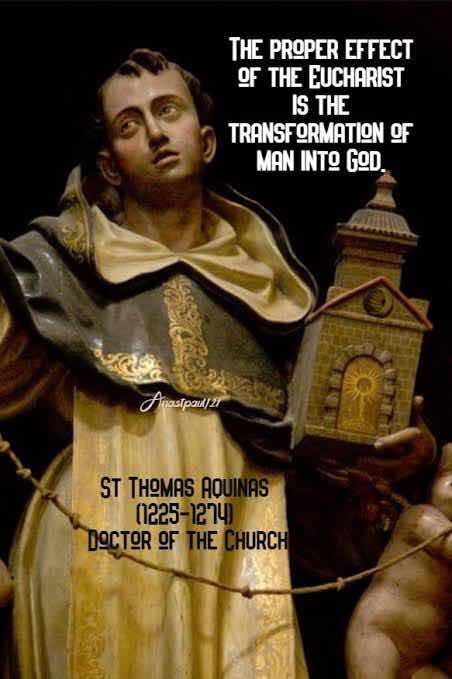
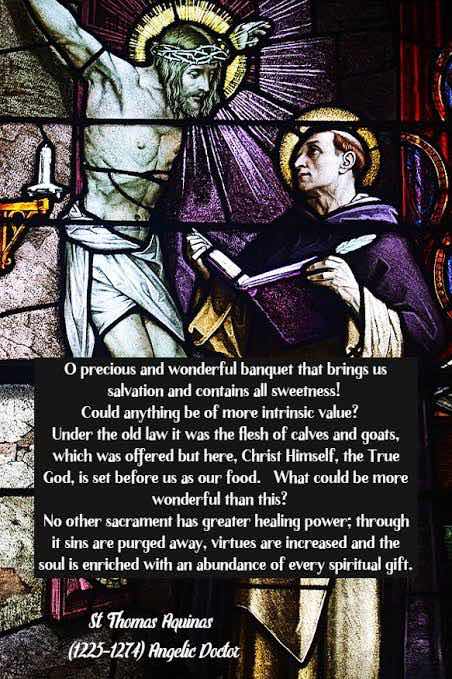
Today we celebrate the Memorial of St Thomas Aquinas - The Angelic & Common Doctor. Angelic because of the heights of perception he achieved philosophically and theologically. Common because his teachings became the norm for Catholic theology especially after the Encyclical of Pope Leo XIII.  

St Thomas Aquinas is one of those figures in Church history that are either loved or hated. For those who love him - he is the model of wisdom and learning, the perfect combination of philosophy and wisdom who continues to teach the Church today. For those who hate him - he is a rigid, pedantic thinker who ruined theology by introducing Aristotelian philosophy and made it a dry intellectual exercise, thereby corrupting Catholicism. 

But who is the real St Thomas Aquinas? 

St Thomas Aquinas is arguably one of the greatest minds produced in the West. He was a Dominican friar who learnt philosophy and theology from his professor, St Albert the Great. It was St Albert who introduced him to the philosophy of Aristotle. 

Christian philosophy in the West and the East had always primarily been influenced by Plato. Arguably it was Neoplatonism that influenced the majority of Christian language, terminology and thought. Neoplatonism is a highly mystical, abstract and spiritual philosophical school of thought that lent itself very well to the early Church Fathers as they were developing theology to explain the faith (especially regarding the mystery of Trinity). 

The Church Fathers however, were not only influenced by Neoplatonism. Many were also influenced by Stoicism, especially St Clement of Alexandria and to a lesser degree it is argued that the Desert Fathers (especially Evagrius Ponticus) were too. In fact our understanding of the virtues, the deadly sins and the Logos all come from or developed out of Stoicism. 

So why did St Thomas Aquinas begin to use and appropriate Aristotelian philosophy instead of sticking with Neoplatonism? He integrated it so much into his thought, that it is often said that Aquinas “baptised Aristotle” ie.. his thought. 

Due to history, wars and tragedies - manuscripts were often lost, burnt or stolen. So in the West, the writings of Aristotle were mostly unknown, or only known through secondary sources up until the 1200’s. This is why Neoplatonism was the dominant influence in philosophy and theology. So this is the context of St Thomas Aquinas and his writings. 

It was St Albert the Great, who taught St Thomas and introduced him to the philosophy of Aristotle. So with this foundation and example from his holy teacher and mentor, he learnt to synthesise Aristotelian philosophy with the faith and so find new ways to explain theology for new generations of students. This was such a novelty and ongoing controversy at the universities at the time, that he was even accused of heresy! 

Philosophy is human language and reasoning trying to understand reality. Whereas theology is man’s response to the Revelation of God and so is faith trying to find expression is human language. So although St Thomas Aquinas found the philosophy of Aristotle useful - he only ever saw it as a means to an end. It was a way of explaining and understanding truth, to come to the ultimate Truth which is God. 
  • It was St Thomas Aquinas who developed the so called “5 ways” of knowing/proving the existence of God (Motion, Efficient Cause, Necessity, Gradation/Degree, Design) 
  • It was St Thomas Aquinas who developed our understanding of the full human person as a body and soul. Not a soul caged in a body, but an embodied soul. A body that cannot exist without a soul and a soul that cannot exist without a body - embodied soul and ensouled body. Personhood requires both, body and soul to be fully human. 
  • It was St Thomas Aquinas who helped us to understand that if God is truth, then whatever is true can only lead is to God. Therefore there is no opposition between faith and reason. Through reason and the study of things (science) we can come to knowledge of reality, however that can only allow us to under understand things to a degree. So ultimately reason needs the illumination of Faith to be elevated to understand ultimate Truth which is God. 
  • It was St Thomas Aquinas who formulated the famous phrase of “grace builds upon nature”. This means that nature (our physical body, dispositions etc) is good, and reflects the goodness of God in creation. However due to sin we are not able to have union with God, we need grace. So grace is what elevates and perfects us, so we can share in the friendship of God and have union with God. So the spiritual life requires development of the virtues and respecting the goodness of creation, that then through grace is elevated and perfected. 
  • It was St Thomas Aquinas himself who helped developed the teaching and understanding of the mystery of the Real Presence of Christ in the Eucharist - what we call Transubstantiation. 
The most famous of the writings of St Thomas Aquinas is his Summa Theologiae. This was his systematic explanation of theology he wrote for his students (although it was never finished. He also wrote the Summa Contra Gentiles which is more of an apologetics books on theology, as well as biblical commentaries and commentaries on the writings of Aristotle. His rigorous application of logic when discussing theology and his insistence on defining terms is what has given him the reputation of his detractors of someone who is a dry intellectual with no soul or love. However this could not be further from the truth! 

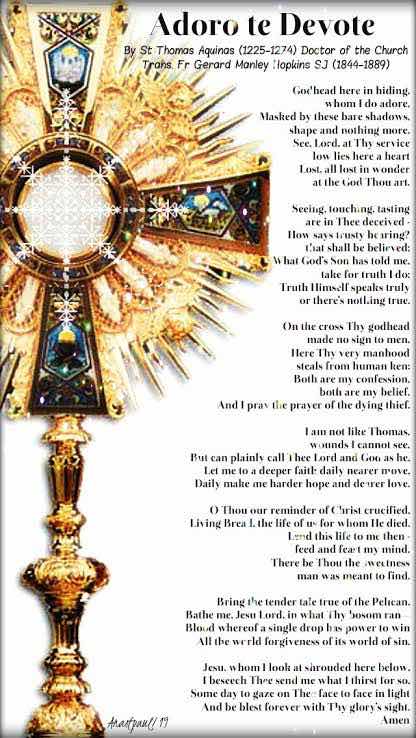
It is often forgotten or taken for granted that some of the most famous prayers and hymns in Catholicism were written by St Thomas Aquinas himself. Anytime you’ve been to Adoration with Benediction and sung O Salutaris Hostia at the beginning or ended with singing Tantum ergo - you are singing words written by St Thomas Aquinas. If you have ever been to a wedding and heard the song Panis Angelicus, that was also written by him! 

These beautiful poetic hymns are packed with dense theological meaning. Only someone in love with God could have written such words. So don’t be fooled into thinking St Thomas was a boring, dry medieval philosopher. He was a true mystic! 

God for St Thomas was not an abstract concept removed from everyday life. God reveals and manifests himself to us through creation, nature, beauty, friendships and truth. But for St Thomas Aquinas, none of this could match the mystery of Jesus in the Eucharist. It was the Eucharist that informed and permeated all his life and search for God, and it was the Eucharist that for him was the greatest expression and manifestation of God’s love for us. 

May St Thomas Aquinas through his example and doctrine, help us to deepens our love for the Blessed Sacrament - so we too can grow in charity for God and our neighbour, this sharing in the beatitude we were all created for. 


Saturday, January 21, 2023

Fortitude as a gift of the Holy Spirit

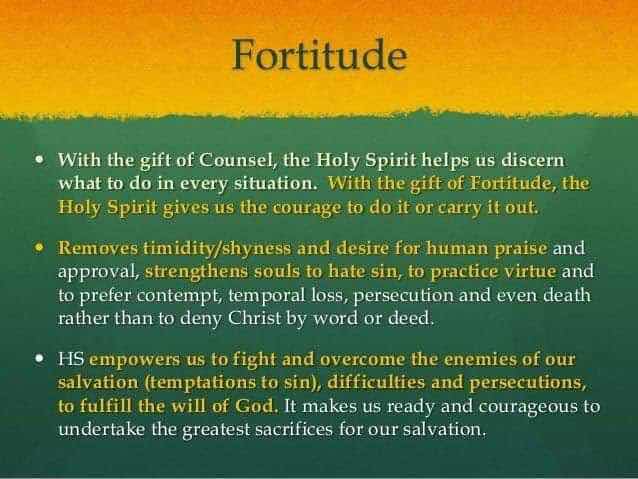
It is not easy to be a Catholic in today's age. So in my own life as a hermit, I have found that fortitude is a virtue and grace that regularly needs to be prayed for and cultivated. When so much around us is based on feelings or emotions, and not based on God's truth or on reason, then it takes fortitude to be able to remain steadfast in your faith, and in loving God.

The Catechism defines Fortitude as follows CCC #1808 
Fortitude is the moral virtue that ensures firmness in difficulties and constancy in the pursuit of the good. It strengthens the resolve to resist temptations and to overcome obstacles in the moral life. The virtue of fortitude enables one to conquer fear, even fear of death, and to face trials and persecutions. 

So fortitude is to remain constant in the face of difficulties. It requires, courage, strength and even at times an act of faith. We have to choose to follow the Holy Spirit and the Gospel even when everything else is telling us we don't have to. So this act of faith, of still choosing to follow God no matter what, is what we call fortitude. In my own spiritual life, I have renamed this as "holy stubborness". This is because at times I have to be so stubborn in my faith, that I have to choose to love God and follow him even inspite of all my sins, failings and weaknesses. But constantly relying on the mercy of God to say "Lord I know you love me, help me to love you more", then getting up and continuing to move forward in faith.

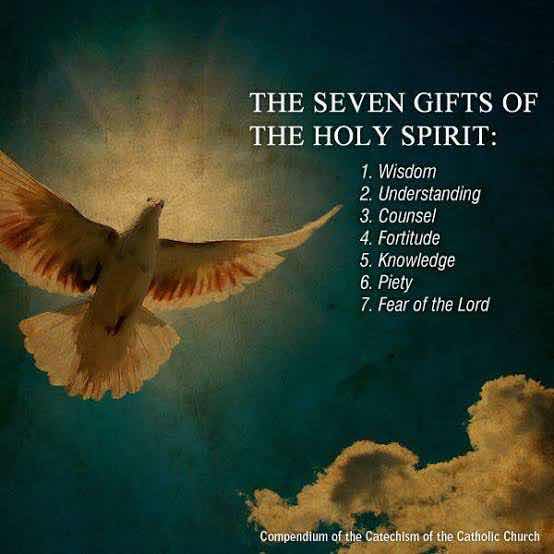
Fortitude is linked to the 7th Beatitude - those who suffer and are persecuted. It is not possible to suffer for the faith, be persecuted and remain faithful to Jesus without the gift of fortitude. This is linked to what I call the empowerment we receive from the Holy Spirit (Acts 1:8) to strengthen us. We receive this initially in Confirmation, and then everyday we can pray for an infilling of this grace from the Holy Spirit.

We can see the gift of fortitude fulfilled by Our Lord in the agony in Garden of Gethsemani (Luke 22:39-46, Mark 14:32-42, Matthew 26:36-46). He says that his soul is sorrowful unto death, but still says that he chooses the Will of the Father - this is Fortitude and Holy Stubborness! 

To choose to follow God and to love him requires an act of the will. This is why St John of the Cross teaches us: 
“Love consists not in feeling great things but in having great detachment and in suffering for the Beloved.” It requires an act of the will, strength, courage, determination to act contrary to how we may feel, and still choose to love God, to follow Him - this is Holy Stubborness, the Gift of Fortitude that we receive from the Holy Spirit who empowers, strengthens and comforts us in the spiritual life.


Wednesday, January 11, 2023

Holy Spirit as the Gift of Christmas

Now that the New Year has begun and the festivities of Christmas have settled down or ended, I wanted to reflect on the Holy Spirit as the Gift of Christmas.

For most of us, we associate Christmas with presents, spending time with family, nativity scenes, Midnight Mass and the infant Jesus. But for most of us the Holy Spirit is not something we associate with Christmas .

The Holy Spirit is the ultimate Gift, the one given to us by the Father and the Son. The Holy Spirit is also the one that empowers us, sanctifies us and gives is the grace to make our life a gift back to the Father through the Son. The Holy Spirit is the gift that enables the Church to continue the sacraments, that gives power and efficacy to them (CCC #739). The Holy Spirit is the soul of the Church that continues to vivify her and all of us as members of the Mystical Body of Christ, the Church. The Holy Spirit also gives us the grace to grow in charity - the divine love we are called to by virtue of our baptism.

St Bernard of Clairvaux referred to the Holy Spirit as the "kiss between the Father and the Son'. What a beautiful image! With this Augustinian understanding of the Holy Trinity, the Holy Spirit is the mutual love between the Father and the Son. So we can also say that the Holy Spirit is the intimacy of the Trinity itself! 

At Christmas we celebrate the mystery of the Incarnation, the Word made flesh - Emmanuel, God is with us! This new level of intimacy with God is the gift we are all offered. To be children of the Father, through union with the Son. Jesus became man, to elevate our humanity and unite it with the Trinity. This is what the Church Fathers all taught, and so if we develop this further - we can also see that the Holy Spirit is the additional gift of Christmas.

The Holy Spirit is the gift given to us to enable and empower us to live our calling as Christians. In baptism we are united to and reborn in Christ, becoming one with him. So too, we also become temples of the Holy Spirit. The indwelling of the Holy Spirit enables us to call God "Abba, Father" (Romans 8:15) and to also be sons in the Son. The Holy Spirit is the one who teaches us to pray (Romans 8:26), to understand the teachings of Jesus (John 14:26), He heals us of our woundedness and sin, and is the one who comforts us and advocates for us (John 14:15, John 14:26)

The Holy Spirit is the gift of intimacy that we receive as our birthright as Christians. Marked, signed and sealed by the Spirit (Ephesians 1:13), we are led by the Spirit and given the freedom of the children of God (2 Corinthians 3:17). How can this not make us exclaim in wonder and joy? The Holy Spirit gives us freedom, joy and love! (Galatians 5:22-23)

So this Christmas, let us remember the gift that Jesus us given us - the Holy Spirit. The bond of the Trinity, the kiss between the Father and the Son, the intimacy of the Trinity itself. This is our gift we have received and can call upon everyday! The Lord the giver of Life - the Paraclete, our Comforter and Advocate is the gift of love that helps us to experience and know the love of God (Romans 5:5), the intimacy of the Holy Trinity.

This is invitation we have from the Holy Spirit himself this New Year, and every moment of our lives -

"The Spirit and the bride say, “Come!” And let the one who hears say, “Come!” Let the one who is thirsty come; and let the one who wishes take the free gift of the water of life." (Revelation 22:17).

Will you accept the invitation and the gift?


Sunday, January 8, 2023

The manifestation of God - hidden glory revealed

Today we celebrate the wonderful feast of the Epiphany - the manifestation. This is also known as the Theophany - the appearance of God visibly manifesting himself. 

Theophanies are remembered throughout the Old Testament with Jacob wrestling with God, Abraham and Sarah providing hospitality to the 3 angels, Moses seeing the Burning Bush , the Pillar of Fire and Cloud that led the Hebrews out of Egypt (Genesis 18:1-15, Genesis 32:24-30, Exodus 3:2, Exodus 13:20-22). These were special moments of encounter - God personally revealing and manifesting himself to his people to form relationship. 

So what encounter is being remembered and celebrated today? For most people, today is associated with the Magi - the three wise kings who brought gifts of gold, frankincense and myrrh to the newborn Jesus. However this feast celebrates more than just that. 

This feast focuses on the manifestations of Christ as God in the flesh, the pivotal moments of the life of Christ that revealed or manifested the divinity of Jesus. 

So today the Church celebrates - the homage of the 3 Magi, the baptism of Jesus in the Jordan, and the miracle at the wedding of Cana. But what is it about these 3 events that are so pivotal to be highlighted in todays feast? 

With the 3 Magi, we see the fulfillment of the prophecy in Isaiah chapter 60. This chapter mentions that foreigners and kings will worship the God of Israel, bring him homage as well as gifts of gold and incense. This is connected to Isaiah prophesying about the light of God that will shine on his people and the glory that will appear or manifest when the  pagan nations help restore Jerusalem and the scattered remnants of Israel are brought back to Zion for a time of peace and worship. 

So the 3 Magi bringing gifts to the newborn King of the Jews had messianic and salvific meaning. The gifts of gold recognise the kingship of Jesus, the frankincense his divinity - because frankincense was reserved for worship. But the Gospel also mentions myrrh - this is an embalming perfume ointment. So this gift symbolises the death that Jesus would undergo as part of our salvation. This is why the event of the 3 Magi is an Epiphany or Theophany - it manifested the hidden identity of Jesus Christ our Saviour. 

The next event is the baptism of Jesus in the Jordan river. This is also celebrated as a separate feast in the Church because of the multiple meanings it has. So why is it connected to Epiphany? 

When Jesus was baptised, the voice of the Father proclaimed “This is my beloved son” (Mathew 3:17, Luke 3:22) and the Holy Spirit appeared over him like a dove. So this was a full manifestation of the Holy Trinity - a Theophany. Jesus is revealed as the Beloved Son of the Father, filled with the Holy Spirit. The hovering of the Holy Spirit over Jesus is reminiscent of the Holy Spirit hovering over the waters of creation (Genesis 1:1-2), as well as the dove who brought Noah an olive branch after the flood (Genesis 8:10-11). This was to show that through his own baptism, Jesus has sanctified the waters of the new creation, so in baptism we become a new creation in him. 

Then we come to the miracle at the wedding feast of Cana. This can seem a bit strange compared to the other two manifestations because it doesn’t have as much obvious symbolism. But the Gospel of John tells us that by the miracle of turning water into wine, Jesus was manifesting his glory (John 2:11). So the Gospel itself says that this was an epiphany. 

This miracle is the beginning of the public ministry of Jesus. It is the inauguration of the Kingdom of God - through miracles, Jesus is revealing his divinity as the Son and manifesting the Kingdom of God is beginning. The Kingdom of God is inaugurated with a wedding feast, and will be completed at his own wedding feast - the Wedding of the Lamb (Revelation 19:9). Just as Jesus turns water into wine, so too he tells the Apostles after he institutes the Eucharist that he will not drink wine again until he enters into the Kingdom (Matthew 26:29, Luke 22:18). 

So the miracle at the wedding of Cana is Eucharistic, but also Messianic. Through this first miracle, Jesus manifests his divinity and inaugurates the Kingdom of God. 

As a child receiving homage from the Magi, at His baptism in which the Holy Trinity manifests, and at the wedding of Cana where he reveals his identify - these three moments powerfully proclaim, reveal and manifest the identity of Christ and our salvation. 

This is what the Church celebrates today in this Feast of the Epiphany. The Messiah King descendant of David is acknowledged by the nations to bring them into worship of the true God. This King is also the High Priest who sacrifices himself to purify us from our sins, unites himself to us in the waters of baptism and leaves us the miraculous wine of the Eucharist - which is his wedding banquet that we will one day share in glory, but even now partake of in remembrance of him. 


Wednesday, January 4, 2023

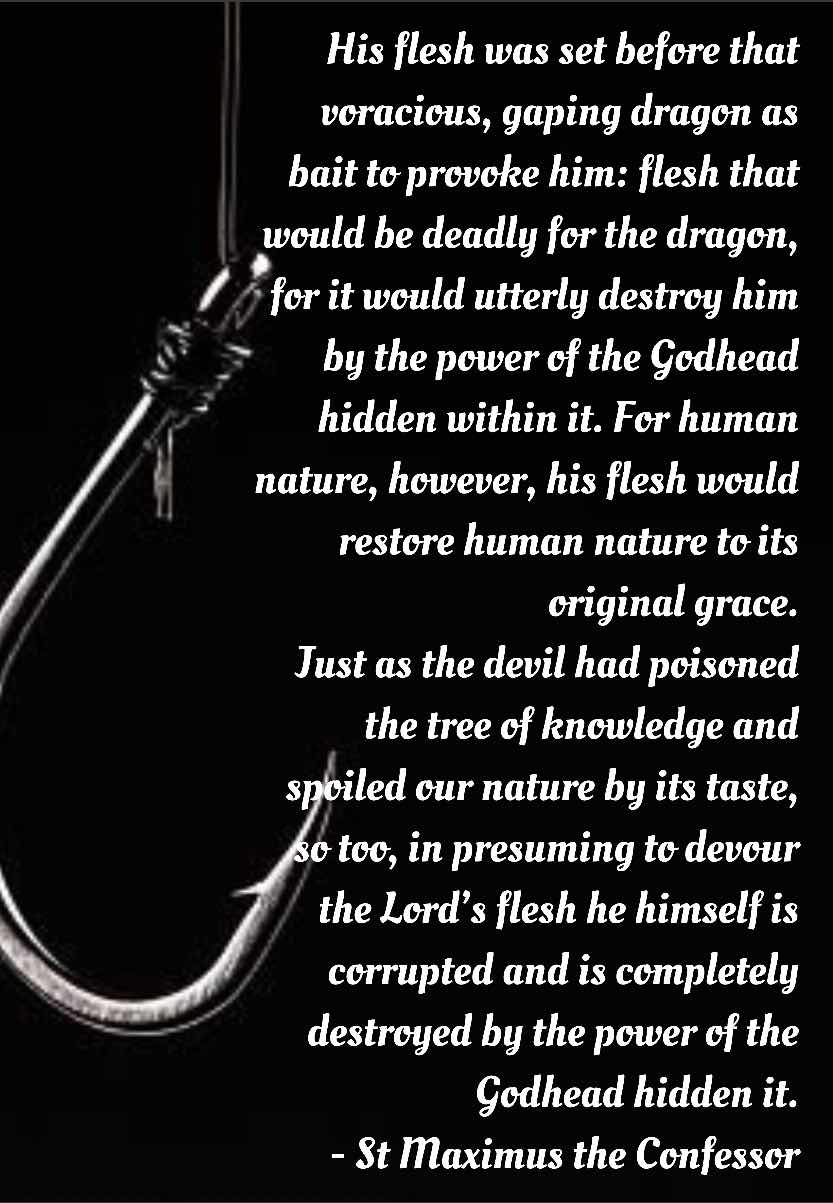
The Humanity of Christ as bait that destroyed death from within

In the 2nd reading for the Office of Readings today, there’s a very interesting excerpt from St Maximus the Confessor - a Byzantine monk and theologian. He is considered one of the Church Fathers and is highly venerated in Orthodoxy and Eastern Catholicism. 

In the quote, he refers to the humanity of Christ as the “bait” by which he hooks in the devil into swallowing him, then by the power of his divinity he is able to poison the devil and destroy him from within. 

This way of understanding and explaining the atonement is known in theology as the Christus Victor theory. Most of us in the Western world are used to hearing the Satisfaction/Substitution theory - by His death on the cross Jesus died in our place and pays the price for our sins, thereby “redeeming” us or buying us back from the power of the devil. 

Both of these views need not be mutually exclusive. They can both be found in the Church Fathers and Saints of the Church. As with most things in theology there are often multipole layers or nuance of meaning. When understood properly they can enrich our understanding of the mysteries of salvation and increase our faith. Just as St Maximus himself says at the end of the quote in the Office of Readings : 
Faith alone grasps these mysteries. Faith alone is truly the substance and foundation of all that exceeds knowledge and understanding.
Faith is always something personal and foundational as outlined in the Catechism paragraph #150. Faith is a response , but it is also an acceptance of truth - divine truth. So faith and salvation are linked, because what we believe needs to be in accordance with God’s revelation, it needs to be accepted and adhered to, and it also needs to change our behaviour. So faith should ultimately always be transformative. This is what salvation is all about - transforming us into a new way of being, new life. 

So with St Maximus’ analogy of bait being the poison that destroys death from within. This can be a powerful image to help up reflect on what we actually believe about our salvation. Does being saved just mean I am now a “good person”? Or does it mean that my entire existence is in a process of transformation and configuration to the image of Christ and the Will of God? 

Through Adam and Eve’s disobedience to God, by believing Satan instead of trusting in God, death then entered the world. Death destroys and corrupts - just like a poison. The poison of hatred, selfishness, pride and greed all destroy and kill us from within. But Jesus through his birth and death, inverts all this. By entering into the belly of death and being “swallowed up” by death, he then is able to bring Life and Light to destroy death from within (1 Corinthians 15:54). 

In the same way that the divinity of Christ was “hidden” in his humanity through kenosis, and it was then able to destroy death and the power of Satan from within. So too, in the Eucharist, the Resurrected Christ is hidden under the appearance of bread and wine, and when we partake of Holy Communion, we receive life and grace that transforms is from within. This transformation from within helps to break the strongholds of the devil in our life, detaching us from sin and purifying us. It also gives us a forestaste of eternal life. 

The Church Fathers often made the connection between the fruit of disobedience bringing death. So the Eucharist is then the fruit from the Tree of Life - the Cross, that brings us eternal life. None of this would be possible without the birth of Jesus, taking on our humanity to make us share in His divinity.

Whether the process of salvation is referred to as sanctification in the West or Theosis/divinisation in the East, the focus is always about transformation in Christ. Participating in the sacraments of the Church is where this program of transformation takes place - specifically in Baptism, Confession and Holy Communion. The humanity of Jesus extended in the Church and prolonged in the sacraments is the medicine to heal us and bring us to fullness of life with Him.